

Cattle Sensor — ROI Calculator
What Does Earlier Detection Save You?
Adjust the numbers to your operation. Every figure below is editable — start from the conservative defaults and model your own expectation.
Your Operation
Total head in the program — one feeding turn's cohort.
Context only — does not affect the ROI.
Your normal death loss over one feeding turn — the share of placed head that die before sale. A hard winter can push this far higher — a 4% loss rate is a real-world reference point.
0.5% — the minimum improvement at which Seismi pays for itself. This is the floor. In practice, earlier detection can cut mortality far more — taking a 4% loss rate toward 2% would be a 2% reduction. Slide up to model your own expectation. Measured in percentage points (2.0% → 1.5%); you can't reduce mortality by more than your baseline rate, so this slider caps at the baseline above.
Cost of a Death
What he weighed coming in.
Tracks USDA feeder steer prices (October 1, 2026 report) as you move the weight above — heavier cattle cost less per cwt. Edit to your own purchase price.
Not the length of the turn — how far in he was when you lost him. Death loss is front-loaded: most of it lands in the first 30–45 days, which is why 30 is the default.
Roughly $0.86/lb cost of gain at 3.5 lb average daily gain.
Processing and treatment sunk into him before you lost him.
Tag Economics
Every animal needs its own sensor, so the upfront outlay is one sensor per head. The cost is then amortized across the sensor's reuses.
See pricing tiers →Each feeding turn is roughly 6 months; 4 uses ≈ a 2-year device life. The per-head cost falls as the sensor amortizes across turns.
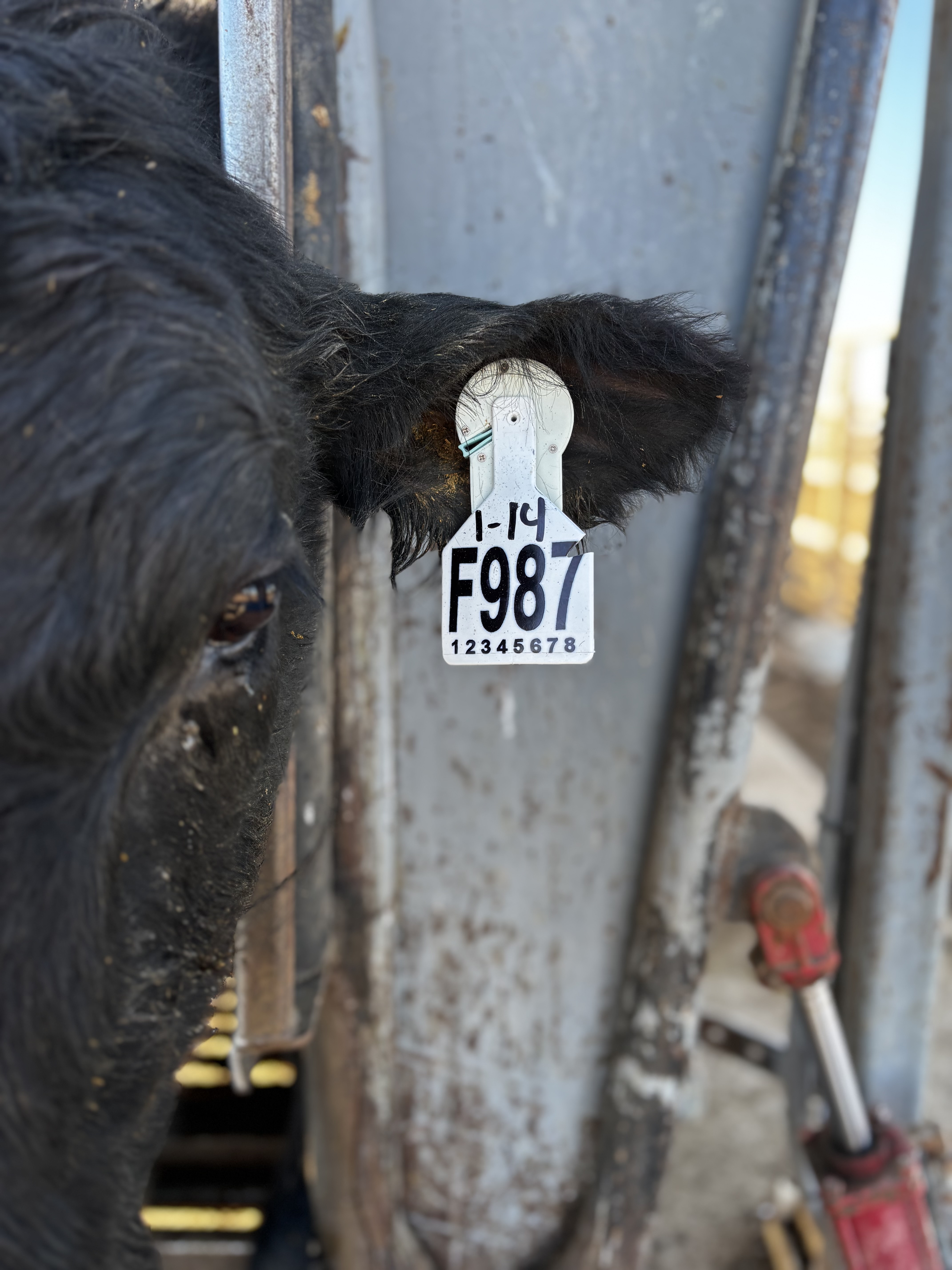
The reusable sensor, clipped behind an existing ear tag — no new puncture.
Net Return
—
Where It Comes From
The Math
Investment
Sources & Assumptions
- What a death costs: the default view values a death at cost basis — purchase price, feed to the day it died, and treatment — which is how a closeout accounts for death loss. The alternate view values it at finished sale weight; that runs high, because it counts revenue the remaining feed was never bought to earn.
- Feeder purchase price: USDA AMS National Daily Feeder & Stocker Cattle AM Summary — Medium & Large #1 feeder steers, October 1, 2026 report (OKC West, Hub City and Winter Livestock auctions). $400/cwt at the 600 lb default. The price tracks purchase weight because feeder cattle sell on a slide: heavier cattle bring less per cwt. A static figure, not a live feed — user-editable to your own purchase price.
- Cattle price (finished-value view): Source: USDA AMS 5 Area Weekly Weighted Average Direct Slaughter Cattle (LM_CT150) — negotiated purchases, live FOB steers, $/cwt live weight; report dated October 19, 2026. Refreshed 2026-10-22 9:14 AM PDT. User-editable to your own contract or sale price.
- Carcass weight context: 959 lb — Source: USDA AMS National Weekly Fed Cattle Comprehensive (LM_CT200) — weighted average carcass weight, beef-type steers & heifers, total all grades, dressed basis; report dated October 20, 2026. Refreshed 2026-10-22 9:14 AM PDT. Context only — the calculator's revenue math uses live weight (finishing weight × live $/cwt).
- Time basis: every figure is per feeding turn (~6 months) — death loss, the amortized sensor cost, and any retrieval cost all apply to one turn's cohort. A year is roughly two turns.
- Benefit-cost ratio: avoided losses ÷ per-turn program cost — dollars recovered per dollar spent, before subtracting the cost itself.
- Mortality default: user-adjustable; a 4% loss rate over the 2025–26 winter is used here as a real-world reference point.
- Retrieval cost: operator-supplied figure, off by default — the sensor is removed with the existing ear tag, so no separate chute pass is required. Charged every turn when enabled (retrieval recurs, so it is not amortized).
- Tag economics: reusable device model; amortization across feeding turns is illustrative.
- Detection: motion-led behavioral monitoring with operator-editable temperature thresholds — it flags genuine candidates, not every post-vaccination temperature spike.
See it in your pens
Bring your own numbers and we'll walk through the math together.